A sketch, not a system. I built it to find out whether the idea held, so read it as thinking rather than as architecture.
precheck
Grant readiness scoring for founders
- Role
- Solo — working prototype in two days
- Since
- 2026
- Status
- prototype
- Stack
-
- Vanilla JS
- Canvas
- Bilingual EN/AR
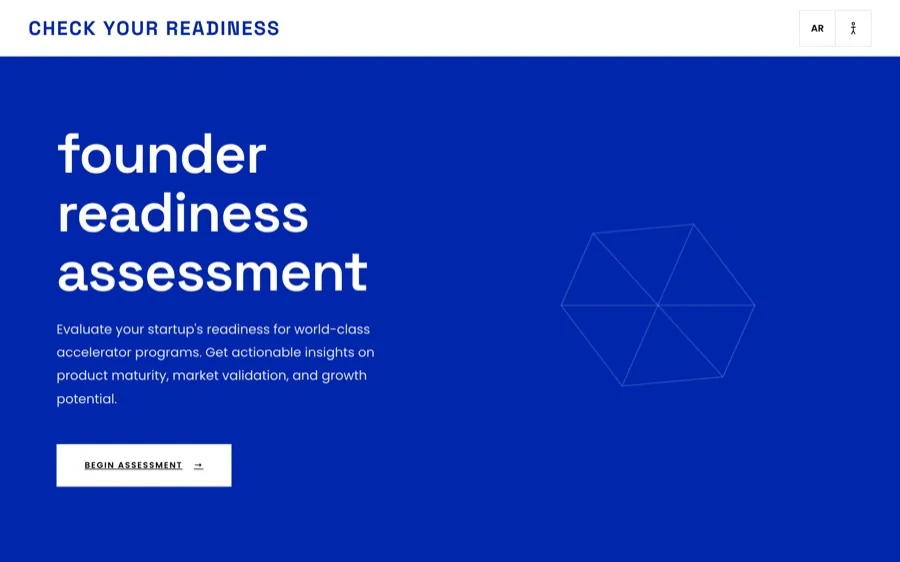
Founders apply for grants they cannot win, and find out three months later.
The criteria are not secret. They are just buried in PDFs nobody reads.
precheck asks the questions an evaluator would ask, and scores you before you spend the three months.
This is a working demo, not a finished product. It shows the result the full system should produce, with the scoring running in the browser and no backend behind it yet.
01 How I thought about it
The value is in the rubric, not the software
This did not need a framework, a backend, or accounts. It needed the real due-diligence criteria encoded honestly. So the engineering budget went into getting the scoring right and the delivery stayed deliberately small.
No backend was a product decision
Founders will not type their weaknesses into someone else's database. Everything runs in the browser and nothing is sent anywhere. That is also why it costs nothing to host and cannot leak.
Bilingual because the applicants are
In the Gulf, many of the founders who need this read Arabic first. English-only would have excluded the users with the most to gain. I do not speak Arabic — the copy was translated and reviewed; what I built was the right-to-left layout and the bilingual scoring output.
The demo comes first, the model comes second
The plan is a learning model on top of this: it takes the internal database of past applications and outcomes, and routes each new application to the programme it actually has a chance with — rather than scoring it against one fixed rubric. That needs a backend, labelled outcome data and a feedback loop, none of which exist yet. So I shipped the part that is useful without them, and made the scoring transparent enough that a model can later replace the fixed weights without changing the interface.
02 Architecture
03 Decisions, with the reason attached
-
No framework, no build step
A single page with no dependencies loads instantly, never breaks on an upgrade, and will still work untouched in five years.
-
Everything client-side
Privacy is the feature. No server means no data to store, breach or explain.
-
A score with reasons, not just a number
A bare number tells a founder nothing. The output names which criterion cost the points and what would fix it.
04 Where it landed
First commit to a working bilingual EN/AR prototype in two days, then refined over the following weeks.
Turns a scattered set of accelerator criteria into an instant scored plan with named gaps.
Proves the interaction end to end, so the routing model has a working shell to be dropped into.
It is a demo. The rubric is a fixed snapshot maintained by hand, and the routing model described above is designed but not built — that needs a backend and real outcome data to learn from. What is live is the scoring logic and the interface it should eventually sit behind.
Building something like this — or putting AI agents into production?
I design AI systems, orchestrate the agents that run them and own the backend underneath. Founding-engineer and systems-architect work, and advisory for teams that need it to run unattended and stay within budget. Abu Dhabi (ADGM) / Remote.